
For decades the desert kingdom has been able to count on the support of Western governments and the silence of the media, but suddenly things don’t seem that simple.
Who would have thought the past two Saudi kings, Fahd and Abdullah, were actually masters of diplomacy? Well that’s exactly what they are being made to look like by the current regime.
In the time of Fahd and Abdullah, all the Saudis needed was a quiet word backed up by a huge lobby in Washington and the West would fulfil their every wish. But after Abdullah died a year ago, he was replaced by dementia sufferer King Salman.
The man who is really pulling the strings however, is his son, Defence Minister Mohammed Bin Salman. A man who in the past year has acted more like a spoilt teenager than a serious world leader, and a man who even his allies are keen to keep at arm’s length.
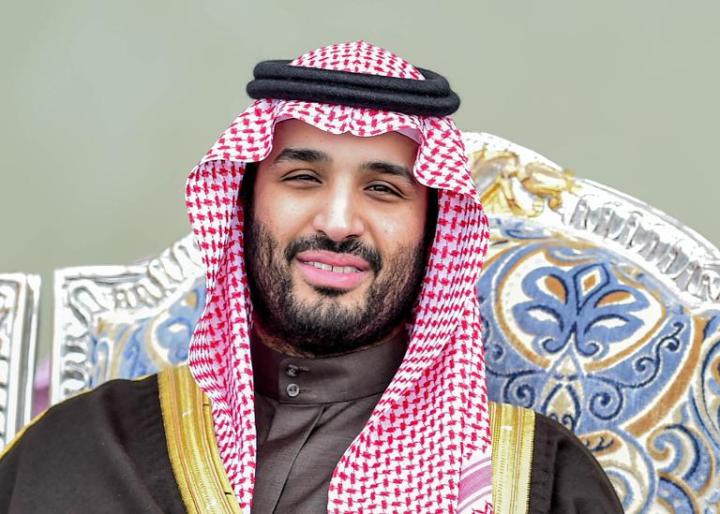
Let’s not suggest everything is Defence Minister Mohammed’s fault though. Circumstances have conspired against Saudi Arabia in many ways, not least the rising oil price and increase in US oil production. Freed from the need for oil, the West is free to judge its relationship with Saudi Arabia on purely strategic merits.
This is exactly the sort of environment where a few home truths could emerge in Western thinking. For example, that regional bad boy Iran is a far less conservative Islamic country, with far better minority rights than Saudi Arabia. Or that unlike Saudi Arabia, Iran has no links whatsoever to terrorists who can operate in Europe (the small size of Europe’s Shia Muslim population would make that unfeasible even if Iran wanted to attack Europe). Or that wounding Russia by removing Bashar Al-Assad from power in Syria would now represent a pyrrhic victory when we consider the Islamist-led chaos that would inevitably follow.
But life is full of small challenges and previous Saudi kings would have always had a Plan B, C and D for such circumstances. And no matter what happened they would never reveal their hand. However, Mohammed Bin Salman’s approach has been more akin to throwing his cards on the table, knocking the table flying and then telling everyone the game is stupid and he’s not playing anymore.
In Syria, the Saudis have stepped up their support to mainly Islamist rebels, forcing Russia to intervene on behalf of the government. And in the region’s poorest country, Yemen, they have launched vicious air strikes aimed at reinstating the democratically elected (in an election where he was the only candidate) president after he was toppled by Shia rebels. However even these two actions were subtle enough not to fully reveal the kingdom’s true intentions for the region.
But any kind of subtlety went out the window last week when they executed Shia cleric Nimr al-Nimr in a move deliberately designed to provoke Iran. In response people in Tehran stormed the Saudi embassy in outrage. But the plan to present the Iranians as hot-headed and a threat to regional security backfired when the government in Tehran condemned the embassy attack and vowed to punish all those responsible.
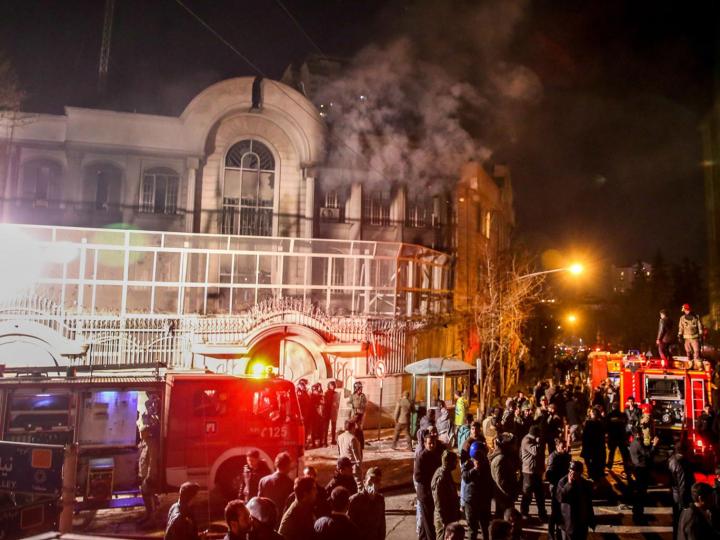
The Saudis did receive a pathetically inaccurate statement of support from British Foreign Secretary Philip Hammond who said while the death penalty should be condemned worldwide, all those executed on January 2nd were terrorists. They weren’t. However Saudi Arabia didn’t get a word of support from the Americans, let alone the cancellation of the Iran nuclear deal which they were hoping for.
After the Saudis cancelled diplomatic relations with Iran, their lead was followed only by a coalition of countries so uninfluential that they probably wished they hadn’t bothered. Only Bahrain, Djibouti, Sudan and Somalia took the step of completely breaking off relations. Other regional powers Qatar and the UAE took the lesser steps of recalling their ambassadors and downgrading relations respectively, while Egypt only issued verbal condemnation of the Iranians. The Arab League was also unable to agree collective action against Iran.
But most disastrous for the Saudis could be the shift in the view of the Western media. Since the executions, publications such as the Economist, the New York Times and the Washington Post which have always supported the Saudi agenda for the Middle East, if not the government itself, have placed the blame for the downturn in Saudi-Iranian relations firmly at the foot of the Saudis and offered only token condemnation of Iran. It goes without saying Western diplomats are having similar thoughts.
Western governments will of course do everything to avoid ditching Saudi Arabia as an ally, not least because any dramatic change in government in Saudi Arabia is most likely to lead to a more extreme form of Sunni Islam. But the approach of the new Saudi leadership is making things more and more difficult every day.
 Sam Street Writes